

Living with bipolar disorder can feel like riding an invisible roller coaster, lurching without warning from sky-high energy and possibility to crushing exhaustion, brain fog, and such low motivation that even tiny tasks require enormous effort. When your provider recommends a medication like lamotrigine, it’s natural to have questions. How does it work? Why does it have to be increased slowly? What dose is right? What side effects should you realistically expect?
Lamotrigine (also known by the brand name Lamictal) is one of the most commonly prescribed mood stabilizers used to treat bipolar disorder, particularly when depression is the dominant pattern.
According to Izunna Ewudo, DNP, PMHNP-BC, psychiatric provider at Neuro Wellness Spa:
“Lamotrigine is a great medication for the management of bipolar disorder, especially in preventing depressive episodes.”
Understanding how lamotrigine works, how dosing decisions are made, what titration actually involves, and how it fits into psychiatric medication management will help you use it safely and effectively.
Bipolar disorder is treatable. The right medication plan, guided by experienced psychiatric care, can help you feel steadier and in control of your mood.
Lamotrigine for Bipolar: Why Psychiatrists Use It
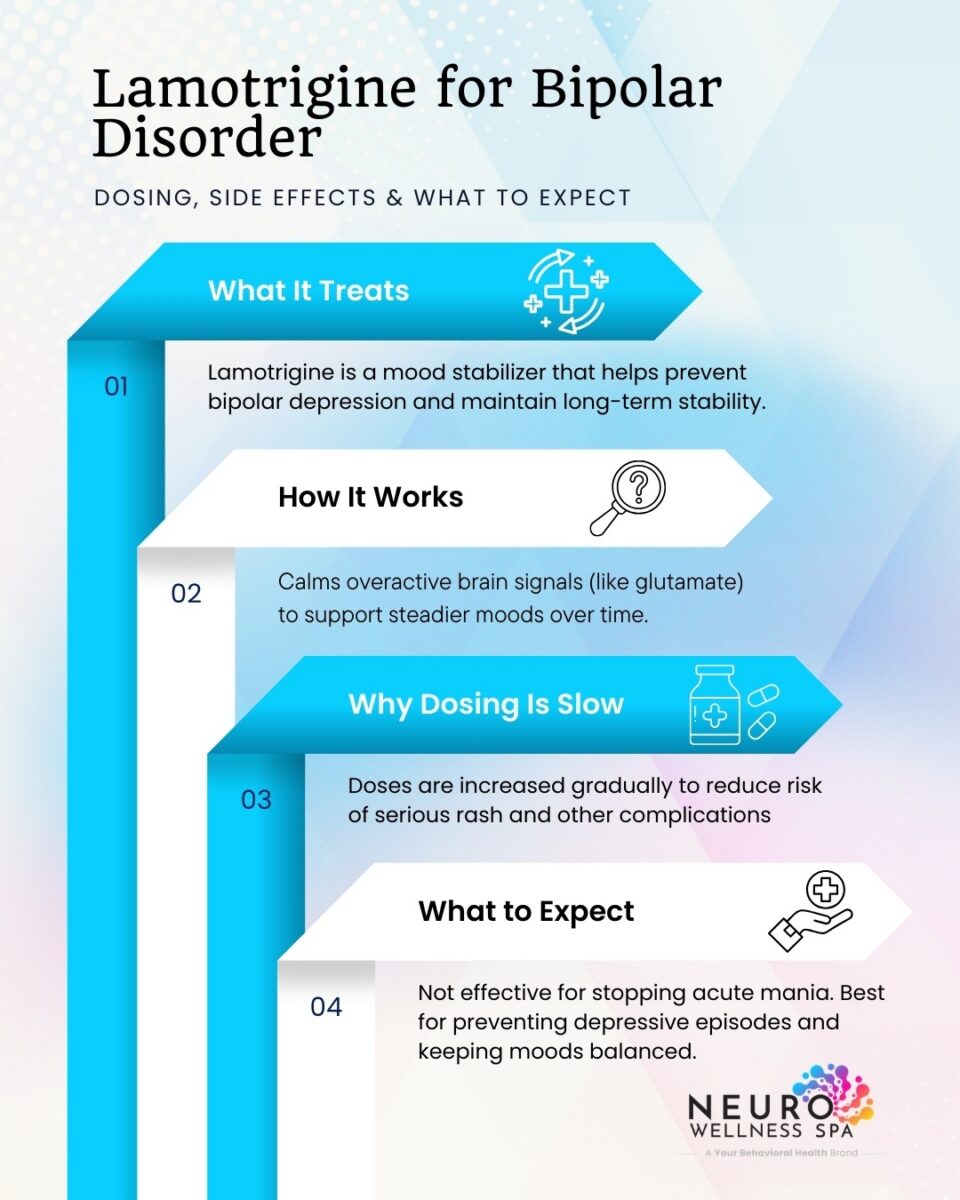
Lamotrigine was originally developed to treat epilepsy and seizures. Over time, research revealed that it also stabilizes mood in people with bipolar disorder.3 Unlike some mood stabilizers that primarily target mania, lamotrigine is particularly effective in preventing depressive relapse and maintaining long-term mood stability.2
It is FDA-approved for the maintenance treatment of bipolar I disorder, meaning it reduces the likelihood of future mood episodes rather than rapidly stopping acute mania.5
Ewudo explains:
“Lamotrigine works especially well for patients whose bipolar disorder is depression-dominant. It’s not typically the medication we use to stop severe mania quickly. It’s a maintenance stabilizer.”
That distinction matters because bipolar disorder is cyclical, and preventing the next depressive episode can be just as important as treating the current one.
Why does lamotrigine work so well?
Lamotrigine helps regulate a brain chemical called glutamate, which can become overactive in bipolar disorder. When brain signals are too intense, mood can become unstable. By calming those signals, lamotrigine supports more consistent mood regulation over time.4
In practical terms, it helps your brain shift from a reactive to a regulated state.
Understanding Dosing: Why Lamotrigine Starts Low
One of the most common questions people ask is:
What is the starting dose of lamotrigine for bipolar disorder?
The typical starting dose is 25 mg once daily.
Ewudo explains the reasoning clearly:
“In psychiatry, we generally start medication at the lowest dose. For lamotrigine, we start at 25 mg because the body needs time to adjust. Rushing the dose increases unnecessary risk.”
Starting low reduces the chance of serious skin reactions and allows your immune system to tolerate the medication safely.5
Unlike some medications that can be increased quickly, lamotrigine requires patience.
What are the standard doses of lamotrigine?
For bipolar disorder, lamotrigine’s therapeutic range typically falls between 100 mg and 400 mg per day.
Many patients stabilize around 200 mg daily, which was the target dose in several clinical studies.1
Ewudo adds nuance:
“For Bipolar Type 2, we often see stabilization around 200 mg. In Bipolar Type 1, especially with more severe cycling, doses may go higher — sometimes up to 400 mg — depending on response and tolerability.”
What is the maximum dose of lamotrigine for bipolar disorder?
While 400 mg per day is generally considered the upper range for bipolar treatment, dosing decisions depend on:
- Bipolar subtype
- Symptom severity
- Other medications
- Medical history
- Individual tolerability
If you are also taking valproate, lamotrigine levels increase significantly, and the maximum dose is usually lower.5
Titration: The Safety Strategy That Protects You
Lamotrigine must be increased gradually to reduce the risk of a rare but serious skin reaction known as Stevens-Johnson syndrome.5
A typical titration schedule follows this structure:
- Weeks 1–2: 25 mg daily
- Weeks 3–4: 50 mg daily
- Week 5+: Increase by 25–50 mg weekly
- Target dose reached around weeks 6–8
This schedule follows FDA prescribing recommendations.5
Ewudo explains how he frames this with patients:
“The slow titration isn’t because lamotrigine is dangerous. It’s because we’re protecting you. When we increase gradually, the risk of a life-threatening skin reaction becomes extremely rare.”
He further reassures:
“I’ve never encountered a patient in my clinical practice who developed Stevens-Johnson syndrome when following proper titration.”
Clinical research supports lamotrigine’s favorable safety and tolerability profile in bipolar disorder when dosed appropriately.1
What does titration actually feel like?
Many people worry that because lamotrigine starts at a low dose, they won’t feel anything for weeks.
In reality:
- Weeks 1–2: You may not notice much change.
- Weeks 3–4: Some patients begin to feel subtle emotional stabilization.
- Weeks 5–8: As doses approach 100–200 mg, mood may feel steadier and depressive intensity may lessen.
Ewudo notes:
“Lamotrigine is gradual. It’s not dramatic. Patients often tell me they just feel more level, less reactive, and less weighed down by depressive symptoms.”
That subtle shift is often the goal.
Related: Understanding Depression Symptoms and How To Cope With Them
What are the Major Side Effects of Lamotrigine?
Most people tolerate lamotrigine well. Common side effects include headache, dizziness, nausea, fatigue, and mild sleep changes.1
Ewudo emphasizes realistic expectations:
“Some patients feel mild dizziness or headache in the first few weeks. Most side effects improve as the body adjusts.”
Serious side effects of lamotrigine
While rare, you should seek urgent medical attention if you experience:
- Severe rash
- Peeling skin
- Flu-like symptoms with rash
- Mouth sores
- Swelling of the face
- Signs of an allergic reaction
The FDA includes a boxed warning regarding serious skin reactions.5
Ewudo also mentions:
“Occasionally, patients report temporary word-finding difficulty — what we call ‘tip-of-the-tongue’ symptoms. If that happens, we reassess the dose.”
If you’re unsure whether a symptom is normal or concerning, having a provider who knows your history makes all the difference.
What to Avoid When Taking Lamotrigine
Certain factors can affect how lamotrigine works in your body.
- Valproate increases lamotrigine levels5
- Carbamazepine may lower lamotrigine levels
- Estrogen-containing birth control can reduce lamotrigine levels by 30–50%5
- Herbal supplements and over-the-counter medicines should be discussed with your provider
- Alcohol may increase dizziness and worsen mood instability
Ewudo emphasizes communication:
“I always tell patients — let me know about any other medications or supplements. Even birth control can change lamotrigine levels significantly.”
Best Practices for Taking Lamotrigine
Lamotrigine can be taken with or without food. Some patients take it at night due to mild sedative effects, while others prefer mornings.
Available forms include standard lamotrigine tablets, extended-release tablets, and dispersible tablets.3
Ewudo advises:
“Consistency is key. Taking lamotrigine at the same time each day helps maintain stable levels and reduces side effects.”
Stability protects your progress.
Managing Bipolar Disorder with Professional Support
Medication is most effective when guided by experienced psychiatric care.
At Neuro Wellness Spa, you have access to:
- Psychiatry and medication management (in-person and online)
- Individual therapy (in-person and online)
- Evidence-based, individualized treatment plans
- Ongoing monitoring to optimize safety and effectiveness
Ewudo summarizes it:
“Medication should never feel mysterious. Patients deserve to understand why we’re choosing a medication, how we’re dosing it, and what to expect.”
Lamotrigine can be a powerful tool in managing bipolar disorder when prescribed thoughtfully and monitored carefully. With proper titration and expert guidance, it offers long-term mood stability for many individuals.
If you’re considering lamotrigine or have questions about your current treatment plan, contact us today to learn more about our online psychiatry and mental health services. We also offer in person services throughout California including mental health services in Lake Forest, CA, mental health services in Santa Monica, CA, mental health services in Sacramento CA, and several other locations. We can help you move forward with clarity and confidence.
Frequently asked questions
Read through our FAQ for any questions you may have about treatment for bipolar disorder, or give us a call today. We are here to answer your questions and support you or your loved one through their healing journey.
How long does lamotrigine take to work?
Because of gradual titration, it may take 6–8 weeks to reach a therapeutic dose. Improvement is often steady rather than sudden.
Why does lamotrigine focus on depression?
Research shows lamotrigine is particularly effective at preventing depressive relapse in bipolar disorder.
What should I do if I forget a dose?
If it’s close to your next dose, skip the missed one. If several days are missed, contact your provider. If you miss lamotrigine for 3–5 days or longer, you may need to restart titration from the beginning. Do not stop taking lamotrigine abruptly without medical guidance.
Can you drink alcohol while taking lamotrigine?
Alcohol may worsen dizziness and mood instability. Discuss safe use with your provider.
Is lamotrigine safe during pregnancy?
If you are pregnant or planning a pregnancy, speak with your provider. Lamotrigine is sometimes continued during pregnancy when the benefits outweigh the risks, but close monitoring is required.
Does lamotrigine cause weight gain?
Lamotrigine is generally considered weight-neutral and typically does not cause significant weight gain, making it appealing for long-term use.
References
- Bowden, C. L., Asnis, G. M., Ginsberg, L. D., Bentley, B., Leadbetter, R., & White, R. (2004). Safety and tolerability of lamotrigine for bipolar disorder. Drug Safety, 27(3), 173–184. https://doi.org/10.2165/00002018-200427030-00002
- Grande, I., Berk, M., Birmaher, B., & Vieta, E. (2015). Bipolar disorder. The Lancet, 387(10027), 1561–1572. https://doi.org/10.1016/s0140-6736(15)00241-x
- National Alliance on Mental Illness. (2025, November 14). Lamotrigine (Lamictal) | NAMI. NAMI. https://www.nami.org/treatments-and-approaches/mental-health-medications/types-of-medication/lamotrigine-lamictal/
- Stahl, S. M. (2024). Prescriber’s Guide. In Cambridge University Press eBooks. https://doi.org/10.1017/9781009464772
- U.S. Food and Drug Administration. (2025). Lamictal prescribing information. https://www.accessdata.fda.gov/drugsatfda_docs/label/2020/020241s058,020764s051,022251s022lbl.pdf
- Lamotrigine: MedlinePlus drug information. (n.d.). https://medlineplus.gov/druginfo/meds/a695007.html