

Have you ever experienced a time in your life when you should have felt sad, happy, or excited, but instead you felt completely numb? Emotional numbness can happen after you experience a traumatic event or during any situation where you feel overwhelmed by what’s going on around you. It can also seem to happen out of nowhere. Learn more about what emotional numbness is, what causes it, and how to start feeling like yourself again.
Are you feeling emotionally numb and are unsure what to do about it? Our professional therapists at Neuro Wellness Spa can help. Reach out today to start your journey towards better mental health.
What Is Emotional Numbness?
Emotional numbness is characterized by an inability to feel any emotions, whether they’re positive or negative. The normal “ups” and “downs” of life that most people experience are nonexistent, and you may feel like you’re living on “autopilot.” You may also feel dissociated from the environment and those around you.
As Alexandria Schuller, LMFT, one of the therapists at Neuro Wellness Spa in Encino, states:
“Emotional numbness is our mind’s quiet way of saying ‘this is too much right now.’ And while it may distance you from pain, it also shows that some part of you is still working to keep you safe, until you’re ready to feel again.”
Why Do People Feel Emotionally Numb?
In some cases, this numbness serves a purpose and protects you from experiencing strong negative emotions. But while some people can navigate difficult feelings and then find positive ways to cope, others shut down completely. The following are some other possible causes behind emotional numbness.
Taking Certain Medications
Some anti-anxiety medications can have side effects, including emotional numbing.1 If you’re getting treated for conditions like anxiety or depression and medication management is part of your plan, then it’s important to recognize the signs of emotional disconnection. This may signify the need to adjust your medication.
Related: Emotional Blunting: What It Is and What You Can Do
Trauma and Stress
If you are exposed to traumatic or stressful events, you are at a higher risk of experiencing emotional numbness. Examples of trauma include car crashes, the death of a loved one, exposure to violence, neglect, and physical or emotional abuse. To cope, you may shut down emotionally. Emotional numbing is also a common symptom associated with posttraumatic stress disorder.2
Difficulties With Emotional Processing
Some people who have a hard time understanding how they feel may use maladaptive behaviors to cope. Research indicates that people who have lower levels of emotional clarity may revert to numbing behaviors.
Mental Health Disorders
Emotional numbness is associated with mental health disorders like anxiety and depression. For example, a common symptom of depression is having a “flat” affect, where you may be unable to feel happy or sad. Feeling panic or anxiety may also lead to your nervous system shutting down, resulting in emotional numbness.
Emotional Numbness Symptoms
Another term for emotional numbness is “affective blunting.” Someone who is experiencing emotional numbness not only has trouble feeling emotions but also expressing them. Some other symptoms of emotional numbness include:
- Feeling like you’re on autopilot – You go through the motions of the day (like waking up, going to work, and making dinner), but it feels like you’re not really there.
- Feeling blank – Instead of experiencing happiness, sadness, or anything in between, it seems like there’s a hollow spot where you know you should feel something.
- The “glass wall” effect – It feels like there’s a sheet of glass or even a thick layer of fog between you and the rest of the world. You can see what’s happening around you, but you don’t feel like a part of anything.
- Lack of a “spark” – Things that used to be exciting, like meeting with friends or going to the movies, don’t give you that “rush” anymore.
- Inability to cry (or laugh) – Even when you know something is sad or funny, you feel as though your emotions are “stuck” and you can’t get them to come out.
Another sign of emotional numbness is feeling uneasy when others around you express strong emotions. You may even distance yourself from them to avoid feeling awkward.
Related: What is Functional Freeze? Signs, Causes, and How to Get Out of It
How Emotional Numbness Can Affect Daily Life
If you’re dealing with emotional numbness, you probably still go about your daily routine. However, you feel disconnected from everything that’s going on around you. Your favorite hobbies that once brought you joy now feel boring, and it’s hard to bring yourself to care about things that once mattered so much to you. It can also make you feel lonely, even if you’re in a crowded room or surrounded by people you love.
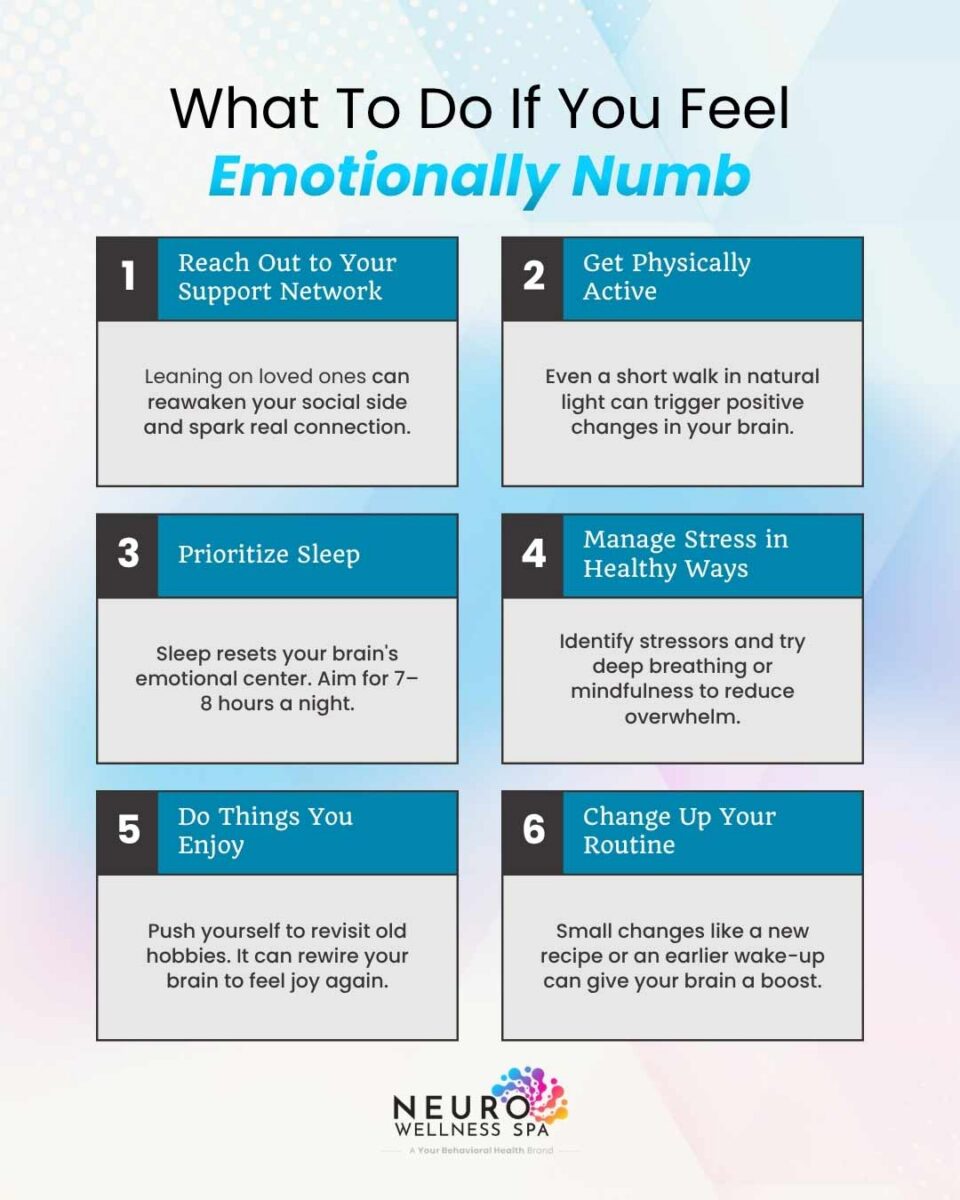
What To Do if You Feel Emotionally Numb
Emotional numbness can feel isolating. But recognizing that there’s a problem is the key to healing. Structure, consistency, and reaching out for help can all provide you with a stable foundation to start to feel like yourself again.
Reach Out to Your Support Network
Those who feel emotionally numb tend to disconnect from their friends and family. When you lean on your support network, it can help wake up your “social” side and spark that connection. Call or reach out to your loved ones to help you start feeling again. They can provide you with guidance and encouragement as well as trigger positive feelings.
Get Physically Active
Movement is a great way to lift your mood and reduce depressive symptoms if you are also struggling with those. Even a short brisk walk outside on a sunny day exposes you to natural light, which can trigger positive chemical changes in your brain.3
Prioritize Sleep
Sleep acts like a “reset button” for your brain’s emotional control center.4 When you don’t get enough sleep, your brain’s ability to process and manage your feelings doesn’t work as well, which can lead to that robotic or numb feeling. Some conditions that cause emotional numbness (like anxiety, depression, and PTSD) also interfere with your ability to sleep. Try to get at least 7 to 8 hours of rest a night.
Related: What Is Sleep Hygiene? 10 Sleep Routine Tips To Improve Mental Health
Find Healthy Ways To Manage Stress
Constant stress can lead to feeling overwhelmed, which may cause you to shut down emotionally as a protective mechanism. If you struggle with emotional numbness, you could be dealing with too many stressors. Try to identify what’s causing you stress and do what you can to minimize it. Practicing deep breathing and mindfulness can be an effective way to manage stress.5
Push Yourself To Do Things You Enjoy
When you feel numb, it’s hard to feel motivated to do anything, even things you once loved. While it can be hard, push yourself to spend time doing those things again. This is called “behavioral activation”, and it can be a helpful way to “re-wire” your brain into triggering small releases of dopamine and bring you joy again.6
Change Up Your Routine
Doing the same thing every single day can be emotionally draining. When you’re stuck in a “rut,” it can lead to emotional numbness. Become unstuck by changing up your routine. Get up a little earlier than usual and go for a walk. Try out new recipes or enroll in a class at your local community college. Changing up your routine, even in small ways, can help wake up your brain and bring color back into your life.
How Therapy Can Help With Emotional Numbness
Therapy can look different for those struggling with emotional numbness depending on the underlying cause. Helpful treatment approaches can include medication management, individual therapy, and building new skills and coping strategies.
Medication Management
Sometimes, medications used to treat other mental health disorders can cause emotional numbness. For example, SSRIs work by dampening your emotional intensity. If the dose is too high, however, it can lead to emotional numbing, affecting your quality of life. An adjustment may be necessary to lessen these effects.
Talk Therapy
Sometimes, other causes of emotional numbness take more work to understand (and treat). In these cases, talk therapy can be a helpful way to understand the source of your emotional blocks and learn more positive coping tools. Different therapy approaches can help resolve any underlying issues behind your emotional numbness.
Lifestyle Modifications and Coping Strategies
Another facet of therapy involves learning how to live a healthier lifestyle and prioritizing self-care to help manage emotional numbness. These activities can include prioritizing sleep, making healthier food choices, journaling, and connecting with friends, family, and support groups.
If emotional numbness is affecting your daily life, contact our mental health professionals today. We’re here to help you reconnect with yourself.
Reconnecting With Your Emotions Starts Here
Emotional numbness can be a lonely experience. But you don’t have to deal with it all by yourself. At Neuro Wellness Spa, we offer in-person and online talk therapy to help you understand what’s behind that sense of disconnection and begin rebuilding your emotional awareness. For some, psychiatry and medication management available both in-person and online can also play a role in reducing numbness and supporting more balanced emotional experiences.
Reach out to Neuro Wellness Spa to find out how we can help you reconnect with your emotions at a pace you are comfortable with.
Frequently asked questions
Read through our FAQ for any questions you may have about emotional numbness, or give us a call today. We are here to answer your questions and support you or your loved one through their healing journey.
Why do I feel emotionally numb?
Emotional numbness is a protective mechanism where your brain “shuts down” your feelings to save you from overwhelming trauma, burnout, or stress. It may also be a symptom of mental health conditions like PTSD or depression.
Is emotional numbness a trauma response?
Yes, emotional numbness is a common trauma response and is often seen in those diagnosed with posttraumatic stress disorder. It is basically your nervous system’s defense mechanism moving into a “freeze” state.
Can emotional numbness be reversed?
Yes, emotional numbness is reversible. Because it stems from a survival response, reversing it requires teaching your body that it is now safe enough to feel your full range of emotions again. It is usually a slow transformation, but it is possible to reconnect with your feelings again.
Sources
- Ma, H., Cai, M., & Wang, H. (2021). Emotional Blunting in Patients With Major Depressive Disorder: A Brief Non-systematic Review of Current Research. Frontiers in psychiatry, 12, 792960. https://doi.org/10.3389/fpsyt.2021.792960
- Litz, B. T., & Gray, M. J. (2002). Emotional numbing in posttraumatic stress disorder: current and future research directions. The Australian and New Zealand journal of psychiatry, 36(2), 198–204. https://doi.org/10.1046/j.1440-1614.2002.01002.x
- Wang, J., Wei, Z., Yao, N., Li, C., & Sun, L. (2023). Association Between Sunlight Exposure and Mental Health: Evidence from a Special Population Without Sunlight in Work. Risk management and healthcare policy, 16, 1049–1057. https://doi.org/10.2147/RMHP.S420018
- Goldstein, A. N., & Walker, M. P. (2014). The role of sleep in emotional brain function. Annual review of clinical psychology, 10, 679–708. https://doi.org/10.1146/annurev-clinpsy-032813-153716
- Kriakous, S. A., Elliott, K. A., Lamers, C., & Owen, R. (2021). The Effectiveness of Mindfulness-Based Stress Reduction on the Psychological Functioning of Healthcare Professionals: a Systematic Review. Mindfulness, 12(1), 1–28. https://doi.org/10.1007/s12671-020-01500-9
- Treadway M. T. (2023). Treating Motivational and Consummatory Aspects of Anhedonia. Focus (American Psychiatric Publishing), 21(3), 278–280. https://doi.org/10.1176/appi.focus.20230008