

Many people are simply not getting an adequate amount of sleep — approximately 1 in 3 adults in the U.S. do not meet the 7 to 9 hours of uninterrupted sleep that’s recommended to be healthy.1 The impact of consistent poor sleep can be significant and extends beyond low physical and mental energy, especially for those with pre-existing mental health conditions.
The reasons why some people struggle with getting a proper night’s rest differ from person to person, but one main factor could be poor sleep hygiene. Even if you don’t have a mental health diagnosis but still think your sleep quality could be better, learning proper sleep hygiene practices can be profoundly beneficial. But where do you even begin developing healthy sleep habits?
Here’s a breakdown of what sleep hygiene is, tips to improve your sleep routine and environment, and how it can improve your overall mental health.
Our psychiatrists offer evidence-based mental health treatments and the latest psychiatric medication options through convenient online visits across California or in-person at our locations in the Los Angeles area. Schedule your appointment today.
Understanding Sleep Hygiene: The Foundation of Mental Wellness
The better you understand what proper sleep hygiene practices are, the more equipped you’ll be to create a routine that facilitates deep sleep and quality rest.
Sleep hygiene definition: More than just “getting enough sleep”
When it comes to sleep hygiene, it’s not about simply getting an adequate amount of sleep. However, there is a difference between sleep quantity and sleep quality — even someone that gets 8 hours of sleep may have a disrupted sleep cycle and spend limited time in REM, which is essential for memory consolidation and emotional well-being.
To clarify, sleep hygiene refers to best practices regarding the way you adjust your habits, environment, and behaviors to improve sleep quality. It’s important to remember that poor sleep hygiene is not a personal failing — it’s extremely common and especially challenging in a world where screens are inescapable, outside noises keep us up, and sharing apartment walls offers little sound barrier between us and our noisy neighbors. All these factors can make it extremely easy for poor sleep hygiene habits to develop and interrupt our sleep architecture.
The sleep-mental health connection: Why good sleep hygiene matters
If you have ever gotten a poor night of sleep, you understand how groggy, irritable, overreactive, and down you may feel. On the other hand, you may know how hard it can be to fall asleep when you’re anxious, or feel energized when you’re depressed. It’s no wonder why studies show that people who struggle with insomnia are 17 times more likely to have anxiety and 10 times more likely to have depression,2 and why around 50% to 80% of people with a mental disorder report chronic sleep struggles.3
Looking at sleep through the lens of brain chemistry, we can understand why it’s so important for our mood. During sleep, serotonin, dopamine, and GABA production are supported — all of which are brain chemicals responsible for mood, motivation, and regulating anxiety. If you struggle with insufficient sleep, emotional regulation, cognitive function, and your ability to respond to stress all become impeded. Additionally, the symptoms that come with sleep deprivation closely overlap with those of mental illness, and sleep deprived individuals face increased risk of developing mental health disorders.4
Related: How To Overcome Depression, Starting Today
Identifying Poor Sleep Hygiene: Signs and Symptoms
You might think your sleep hygiene is top notch, but you could be harboring some bad sleep habits without realizing it. Here’s how to spot signs that you may be practicing poor sleep hygiene in your routine.
Recognizing bad sleep habits in your daily routine
There are several bad habits that can contribute to sleep problems. Although it’s understandable that not every aspect of your sleep routine will go as planned, trying to limit these bad habits can help more than you realize and include:
- Inconsistent bedtimes and wake times.
- Screentime, phone scrolling, and other blue light exposure activities right before bed.
- Consuming caffeine a few hours before bed.
- Eating foods that impede your ability to fall or stay asleep.
- Using the bedroom for non-sleep activities and lounging on your bed.
Physical and mental signs of poor sleep quality
According to Therese Apontti, licensed marriage and family therapist (LMFT) for Neuro Wellness Spa in Manhattan Beach, “Sleep is fundamentally important to our health. It helps regulate mood, memory, and our ability to handle stress to build greater resilience. Low-quality sleep is linked to increased anxiety, depression, and reduced cognitive functioning.”
Some physical and psychological symptoms can emerge when you are not getting quality sleep, including:
- Persistent fatigue that doesn’t seem to improve despite getting 8 hours of sleep.
- Irritability and short temper with situations that you’d normally be more patient with.
- Difficulty concentrating and making decisions.
- Difficulty falling asleep despite feeling tired.
- Frequently waking up throughout the night
- Early morning awakening with struggles to fall back asleep.
- Increased anxiety, emotional volatility, and overreacting.
- Depressed mood or anhedonia — the loss of interest in daily activities that once brought joy.
Related: Understanding Depression Symptoms and How To Cope With Them
The Cost of Poor Sleep Hygiene: Understanding Sleep Disorders and Finding Treatment
Poor sleep hygiene can trigger insomnia and worsen existing sleep disorders, often requiring professional treatment to break the cycle. In this video, Dr. Simon Faynboym, medical director (MD) of Neuro Wellness Spa in South Torrance, Long Beach, and Beverly Hills, explains the connection between sleep hygiene and mental health, and when to seek help:
Building Good Sleep Hygiene: 10 Essential Tips for Better Sleep Quality
A good night’s rest can be easier to achieve when you have a consistent sleep hygiene routine. If you’re wondering where to start, here’s a breakdown of 10 healthy practices you can incorporate into your bedtime routine to facilitate longer, deeper, quality rest.
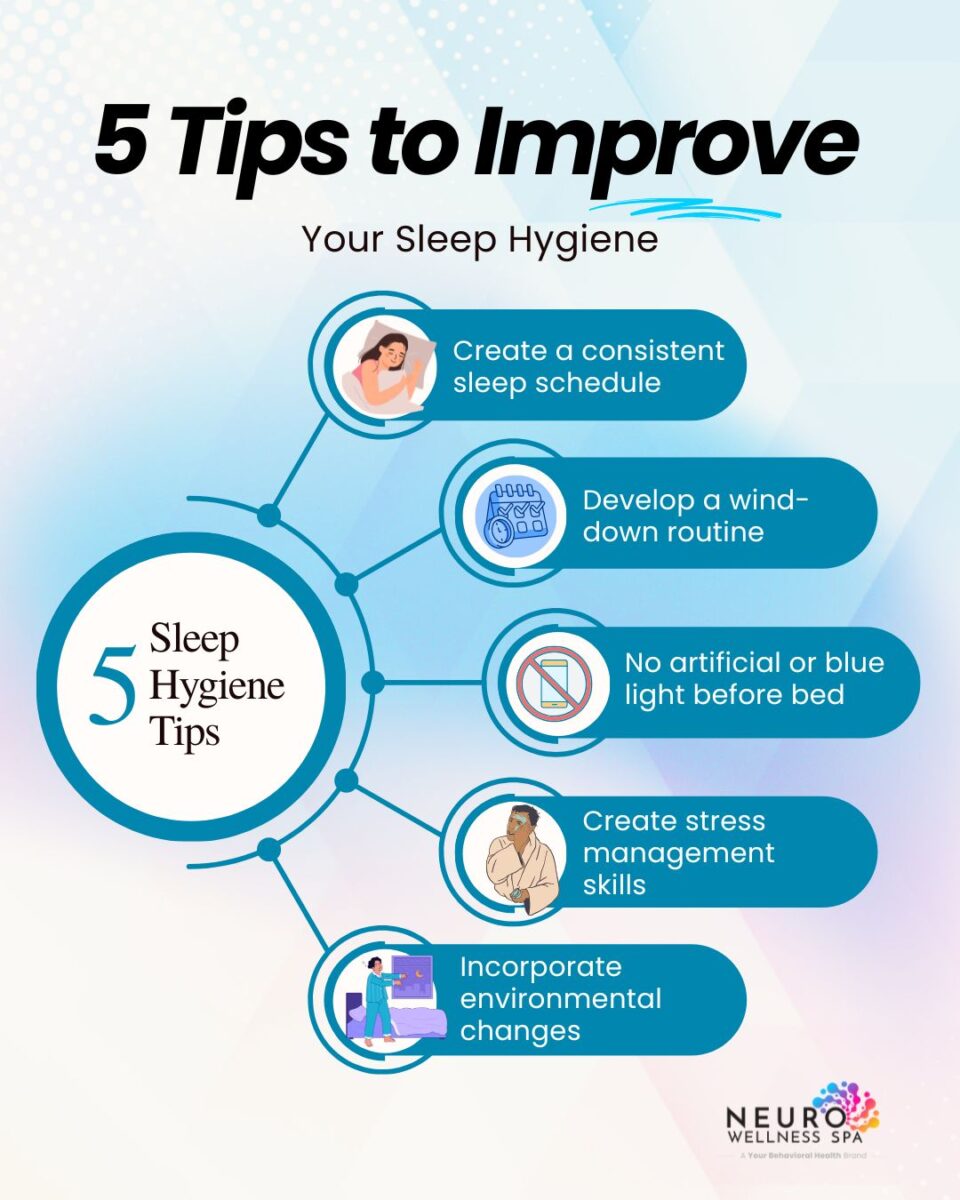
1. Create a consistent sleep schedule
A predictable sleep schedule is the foundation of healthy sleep. When your body’s internal clock becomes accustomed to regular sleep patterns, you’ll naturally start producing the “sleep hormone” melatonin at consistent times, and your body will become better at preparing for waking up. You’ll toss and turn less, experience more sound sleep, and feel more energized in the morning.
Research backs up this sentiment — studies show that consistent bedtimes and wake times are associated with better health,5 including lower rates of cardiovascular complications.6 Additional benefits include improved metabolic health, academic and cognitive performance, and reduced inflammation.7
Maintain consistent sleep times on weekends to avoid “social jetlag”
Social jetlag is when your weekend sleep and wake times are different from your weekday ones. For some professions, social jetlag is more common — nurses, firefighters, and truck drivers often work rotating or overnight shifts that make it difficult to maintain consistent sleep schedules throughout the week. However, for those whose schedules allow for it, avoiding social jetlag may be associated with better health outcomes, including decreased risk of depression, substance use, heart problems, and obesity.8
2. Follow the 10-3-2-1-0 rule to prepare for sleep
One way to create a sleep schedule that facilitates quality rest is to follow the 10-3-2-1-0 rule — a set of well-timed healthy habits that can help you achieve quality sleep and says:
- No caffeine 10 hours before bed or sooner — although 6 hours before bed reflects modern research more accurately and is still good sleep hygiene.9 That’s because a typical adult will take 5 to 6 hours to remove half of the caffeine they’ve consumed from their body.
- Avoid consuming food or alcohol 3 hours before bed. Digesting food takes energy which can disrupt sleep, and while consuming alcohol might help you fall asleep initially, it can lead to reduced REM sleep.
- Refrain from mentally stimulating activities 2 hours before bed. Your brain needs proper time to wind down, and resisting the temptation to continue working late can prevent a racing mind at night.
- Limit screen time 1 hour before bed. LED screens emit bright, blue light, which can disrupt melatonin production. Additionally, using your computer, TV, or phone before bed can arouse your mind, extend the time it takes to fall asleep, and make it harder for you to solely associate your bedroom with sleep.
- Don’t hit the snooze button 0 hours after waking up. Although it may feel tempting to squeeze in a few more minutes of shuteye, you’ll likely enter a lighter stage of sleep and wake up groggier. Additionally, you can confuse your circadian system and potentially trigger your stress response from anticipating an abrupt alarm.
3. Time your meals strategically, and consider sleep-supporting foods
Sleep is not only affected by what you eat, but when you eat it. The timing of your meals ties back to the “3” part of the 10-3-2-1-0 rule for several reasons. For example, eating late can cause sleep disruptions by impeding your digestive system’s circadian rhythm, your body sleeps best when it’s cool and digestion increases your body’s core temperature, and lying down when you’re full can simply be uncomfortable.
What you eat is important too, so be mindful of foods that support good sleep, including:
- Foods that are high in magnesium and complex carbohydrates, which can help promote relaxation for sleep.
- Foods that have natural melatonin, such as:10
- Eggs
- Pistachios
- Mushrooms
- Fish
- Montmorency cherries
- Foods that have high levels of tryptophan, such as turkey and milk.
- Uncaffeinated herbal teas that support sleep, such as chamomile.
However, there are foods that are associated with impaired quality sleep, including:
- Caffeine — it’s best to avoid caffeine consumption like coffee and energy drinks at least 6 hours before bed.
- Alcohol, which may make it easier to fall asleep, but more difficult to achieve deep, quality rest.
- Fatty or sugary snacks, high-fat meals, and spicy foods are not recommended right before bed. They could cause an upset stomach, which could keep you up.
- High-acidity meals, as they can cause uncomfortable acid reflux.
- High-protein meals that require extra energy to metabolize.
- Water — staying hydrated is important for sleep, but avoid large amounts 1 to 2 hours before bed to prevent nighttime bathroom trips.
Related: Holistic Treatments for Depression
4. Develop a consistent wind-down routine
As you’re getting ready for bed, having a 30 to 60 minute wind-down routine can help signal to your mind and body that it’s time for sleep. Relaxation techniques that promote sleep health include:
- Meditation and guided imagery: Listening to guided meditations or practicing mindfulness can calm racing thoughts and reduce physical tension.
- Progressive muscle relaxation: Systematically tensing and releasing different muscle groups helps identify and release physical tension you may have developed during the day.
- Gentle stretching or yoga: Light movement can ease physical stiffness and promote relaxation.
- Reading: Engaging with calm, non-stimulating content can help transition your mind away from daily stressors.
- Journaling: Writing down thoughts or concerns can help clear your mind of lingering worries that may make it harder to fall asleep.
- Breathing exercises: Try the 4-7-8 breathing technique for a calmed nervous system: breath out with an audible “whoosh,” breath in silently through your nose for 7 seconds, and breath out with a “whoosh” for 8 seconds. Repeat at least 3 times.
Implementing any new routine can be difficult, especially if you’re used to scrolling on your phone before dozing off. Try setting a “reverse alarm,” or an alarm 30 minutes to an hour before bed to remind yourself to start your routine.
5. Mindfully manage your light exposure throughout the day
Making sure to stay out of harsh lighting, and manage the blue light you receive from screens can help regulate your circadian rhythm, which is most light-sensitive one hour after you wake up, and about two hours before your normal bedtime. Getting bright, natural light exposure for at least an hour each morning can help you feel awake and alert, according to the National Sleep Foundation.11 Before going to bed, it’s also important to avoid your phone’s bright light, so try having your charging station on the other side of the room to alleviate temptations.
6. Incorporate well-timed, sleep-supporting physical activity
Regular exercise can support a good night’s sleep and even improve symptoms of chronic insomnia, but timing is important. Exercising too close to bedtime can leave you overstimulated and elevate your heart rate, increase your core body temperature, and release endorphins at a time when your body needs to wind down.
Working out in the morning is best for all-day alertness and energy. Studies show that even 10 minutes of light exercise in the morning can increase sleep duration, and moderate-intensity exercise 3 times a week over a prolonged period of time can have the most substantial improvements.12
Related: Mood-Boosting Workouts You Can Do From Home
7. Create technology boundaries and management techniques
Tying back to the 10-3-2-1-0 rule, limiting technology 1 hour before bed can facilitate quality rest. In practice, these boundaries may include:
- A device-free bedroom policy — if your living situation means your bedroom doubles as an office space or living area, you can create a boundary a couple feet from your bed where you don’t use your phone or computer.
- Avoiding any mentally stimulating content before bed, like sensationalized news stories.
- Setting up a “charging jail” — a place to charge your devices that’s outside your bedroom, and buying an analog alarm clock.
- Setting your phone on “Do Not Disturb” when you begin your wind down routine.
You can also use technology to your advantage by implementing strategies that include:
- Sleep tracking apps to help see how long you are spending in deep rest and what your “sleep score” is.
- Adjusting your phone to a dim light setting or using a blue light filter app if you need to use your phone before bed.
- Using white noise apps or devices, such as fan noise, brown noise audio, or sounds of falling rain.
Related: Gaming Addiction in Teens
8. Develop stress management techniques
Stress from our daily lives is often inevitable, but learning how to manage stress to prevent ruminating before bed is key for proper rest. A few strategies to calm your mind and body include:
- The 4-7-8 breathing technique to calm your nervous system.
- Scheduling your worry time by journaling or engaging in creative activities to contain persistent anxiety or rumination.
- Talking to a therapist about what stresses you out.
- Taking brief outdoor walks.
Keep in mind that these strategies just scratch the surface of available coping mechanisms for stress.
9. Environmental fine-tuning for mental health recovery
Optimizing your sleep environment to create a peaceful sleep space is imperative and includes:
- Keep your room cool: Between 65 and 68 degrees Fahrenheit is when your body is best at receiving deep, restorative sleep. Summer months might make this difficult, but air conditioning or using cooling sheets can help.
- Use blackout curtains or an eye mask: Although you may turn off the lights before bed, street lamps, moonlight, and car headlights can seep into your room and interfere with melatonin production. Blackout curtains ensure complete darkness, regardless of external factors.
- Aim to have your bedroom humidity between 30% to 50%: This is generally considered the optimal humidity for sleep, where you avoid the low humidity that can cause uncomfortable and disruptive dry skin and nose bleeds, and the high humidity that can trigger allergies.
- Use an air purifier: This is especially true if you have allergies, which can keep you up at night with congested sinuses.
- Maintain a quiet room: Noise sensitivity can make it difficult to sleep, so make sure to turn off all audible distractions, even if you’re used to falling asleep with the TV on. If you live in a city where loud noises are inevitable, you can mask sounds with white noise, soft music, or ear plugs.
- Use breathable sheets, a comfortable mattress, and supportive pillows: An uncomfortable sleep is not a restorative sleep.
- Use aromatherapy: There’s some evidence that scents such as lavender can calm your nerves and are conducive to relaxation. Although the research isn’t necessarily conclusive, at the very least you can train your mind to associate certain scents with bedtime.
10. Use the 10-minute rule if you are struggling to fall asleep
If you’ve implemented all these sleep hygiene strategies and are still lying awake at night with a racing mind, try the 10-minute rule to help you ease into a relaxed state. The 10-minute rule says that if you’re struggling to fall asleep, get up out of bed and do a calm, quiet activity until you feel tired. This helps you avoid lying in bed, frustrated that you can’t go to sleep, and redirects your attention momentarily.
Related: Stress Management Tips for Rising Costs and Managing Economic Anxiety
How Neuro Wellness Spa Can Support Good Sleep Hygiene for Better Mental Health
At Neuro Wellness Spa, we understand the profound importance of quality sleep hygiene for overall mental and physical health. If you’re having sleep disturbances from mental health disorders — or vice versa — getting professional support is vital. Our empathetic and informed mental health professionals will work with you to strategically figure out a sleep hygiene routine that works best for you, introducing you to effective treatments such as cognitive behavioral therapy (CBT) for sleep.
If mental health disorders are driving your poor sleep, we also offer transcranial magnetic stimulation (TMS) therapy and medication management services to address the root cause. Don’t let bad sleep leave you feeling tired and burnt out — contact Neuro Wellness Spa today to finally rest deeply.
FAQ: Sleep Hygiene
Here are answers to some frequently asked questions about sleep hygiene and developing a proper sleep routine.
Poor sleep hygiene may look like:
– Falling asleep unintentionally while scrolling on your phone or watching TV.
– Going to bed and waking up at dramatically different times throughout the week.
– Sleeping in a hot room.
– Eating large, spicy meals or drinking caffeine right before bed.
– Leaving lights on as you go to bed.
– Habitually hitting the snooze button when you wake up.
– Using alcohol as a sleep aid.
– Taking long naps too close to bedtime.
There is no definitive “best sleep position” — it ultimately depends on your preferences, comfort, and any pre-existing health conditions. For example, if you have sleep apnea, sleeping on your side may help keep airways open. If you experience heartburn, sleeping on your left side can reduce acid reflux. Side sleeping with slightly bent knees can also help accommodate lower back pain.
The most important factor is that your sleep position provides proper spinal support. This could mean side sleeping in a fetal position or back sleeping in a supine position, as long as your spine maintains its natural alignment.13
Your optimal bedtime will depend on your lifestyle, work schedule, and even your chronotype — otherwise known as the early bird or night owl gene. However, keep in mind that adults typically require 7 to 9 hours of sleep. One helpful tip is to identify what time you need to wake up, subtract 7 to 9 hours from that time, and add the 15 to 20 minutes that are typically required to fall asleep. Additionally, sticking to a consistent bedtime and wake time is more important than what that time is.
References
- sleephealth. (2025, June 11). The state of sleep health in America in 2023 – sleephealth.org. SleepHealth.org. https://www.sleephealth.org/sleep-health/the-state-of-sleephealth-in-america/
- Scott, A. J., Webb, T. L., James, M. M., Rowse, G., & Weich, S. (2021). Improving sleep quality leads to better mental health: A meta-analysis of randomised controlled trials. Sleep Medicine Reviews, 60, 101556. https://doi.org/10.1016/j.smrv.2021.101556
- Mental Health America. (2024, December 7). Sleep complications in recovery | Mental Health America. https://mhanational.org/resources/sleep-complications-in-recovery/
- How sleep deprivation impacts mental health. (2022, March 16). Columbia University Department of Psychiatry. https://www.columbiapsychiatry.org/news/how-sleep-deprivation-affects-your-mental-health
- Chaput, J., Dutil, C., Featherstone, R., Ross, R., Giangregorio, L., Saunders, T. J., Janssen, I., Poitras, V. J., Kho, M. E., Ross-White, A., Zankar, S., & Carrier, J. (2020). Sleep timing, sleep consistency, and health in adults: a systematic review. Applied Physiology Nutrition and Metabolism, 45(10 (Suppl. 2)), S232–S247. https://doi.org/10.1139/apnm-2020-0032
- Zuraikat, F. M., Aggarwal, B., Jelic, S., & St-Onge, M. (2023). Consistency is key: sleep regularity predicts all-cause mortality. SLEEP, 47(1). https://doi.org/10.1093/sleep/zsad285
- Sletten, T. L., Weaver, M. D., Foster, R. G., Gozal, D., Klerman, E. B., Rajaratnam, S. M., Roenneberg, T., Takahashi, J. S., Turek, F. W., Vitiello, M. V., Young, M. W., & Czeisler, C. A. (2023). The importance of sleep regularity: a consensus statement of the National Sleep Foundation sleep timing and variability panel. Sleep Health, 9(6), 801–820. https://doi.org/10.1016/j.sleh.2023.07.016
- Islam, Z., Hu, H., Akter, S., Kuwahara, K., Kochi, T., Eguchi, M., Kurotani, K., Nanri, A., Kabe, I., & Mizoue, T. (2019). Social jetlag is associated with an increased likelihood of having depressive symptoms among the Japanese working population: the Furukawa Nutrition and Health Study. SLEEP, 43(1). https://doi.org/10.1093/sleep/zsz204
- Drake, C., Roehrs, T., Shambroom, J., & Roth, T. (2013). Caffeine Effects on Sleep Taken 0, 3, or 6 Hours before Going to Bed. Journal of Clinical Sleep Medicine, 09(11), 1195–1200. https://doi.org/10.5664/jcsm.3170
- Drake, C., Roehrs, T., Shambroom, J., & Roth, T. (2013). Caffeine Effects on Sleep Taken 0, 3, or 6 Hours before Going to Bed. Journal of Clinical Sleep Medicine, 09(11), 1195–1200. https://doi.org/10.5664/jcsm.3170
- Thensf. (2025, March 26). Good light, bad light, and better sleep. National Sleep Foundation. https://www.thensf.org/good-light-bad-light-and-better-sleep/
- Alnawwar, M. A., Alraddadi, M. I., Algethmi, R. A., Salem, G. A., Salem, M. A., & Alharbi, A. A. (2023). The Effect of Physical activity on sleep quality and sleep Disorder: A Systematic review. Cureus. https://doi.org/10.7759/cureus.43595
- Suni, E., & Suni, E. (2025, July 25). Best sleeping positions. Sleep Foundation. https://www.sleepfoundation.org/sleeping-positions