
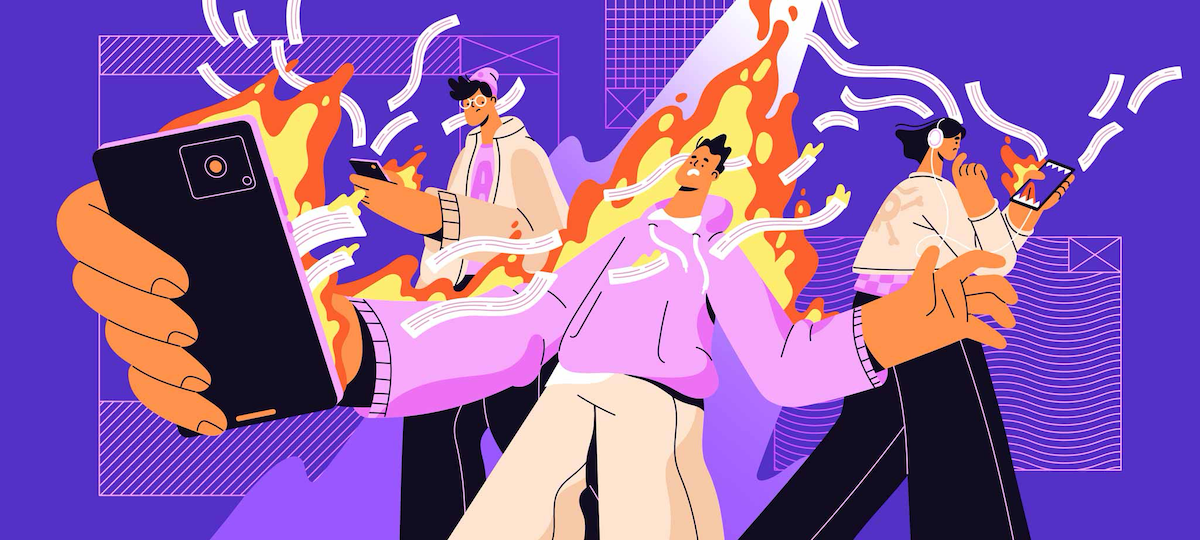
We’ve all done this at some point. It’s right before bed, so you open up your phone and decide to check out what’s going on online. One friend shares a story on a local tragedy, so you click to read more, or you’re just trying to turn your brain off and see what others are doing. One video turns into two, one video on what happened turns into five, ten, fifteen, one hundred. Before you know it, it’s midnight, and you’re not sure how you got there.
This is called doomscrolling: when you endlessly scroll through social media to stay informed or entertained, only to find you can’t look away. This consistent exposure to upsetting news leaves you feeling stressed and overwhelmed. By recognizing this pattern and finding better alternatives, you can create healthier boundaries and learn to unplug.
When Did Doomscrolling Become a Thing?
While this term has been around for a while, this behavior increased among many in 2020 during the COVID-19 pandemic.1 Most of us were stuck at home, relying heavily on our phones and computers for news and entertainment. Social media became a way to connect with others, which led to an abundance of news articles and posts about restrictions, supply chain issues, and, of course, new hospitalization and death counts. No amount of information was enough for many of us as we stayed stuck in a never-ending loop of searching for answers, but finding few, if any.
While 2020 is long behind us, many people still struggle with doomscrolling behavior. Most of us find ourselves regularly swiping our phones and thumbing through an avalanche of negative news shared on social media.
Why Do People Doomscroll?
All behavior serves a function, including doomscrolling. In fact, doomscrolling may start out innocently enough. You may simply want to be more aware of a situation so you can better understand what’s happening and prepare. In 2020, you may have wanted to know if you should wear a mask while walking your dog or if wiping down your groceries is really necessary.
However, with doomscrolling, searching for answers becomes unproductive and even obsessive. Instead of learning and applying any new information you learn, you end up wasting time surfing from one bad story to the next. An hour later, you’re feeling worse about the world and everyone in it.
Doomscrolling can also become a way to cope with difficult emotions. Instead of sitting with stress, anxiety, or uncomfortable thoughts, many people turn to their phones as a distraction. In the moment, it can feel like a break from reality or a way to “numb out.” However, this form of escape is temporary. The emotions you are avoiding don’t go away; they often return more intensely once you stop scrolling, making it harder to break the cycle.
The Mental Health Effects of Doomscrolling
Our brains are hardwired to perceive threats and act accordingly.2 Noticing danger keeps you out of harm’s way before it’s too late. However, this can backfire when it comes to the internet. According to research, doomscrolling in 2020 led to increased feelings of depression and even symptoms associated with PTSD or secondary traumatic stress for some people.1
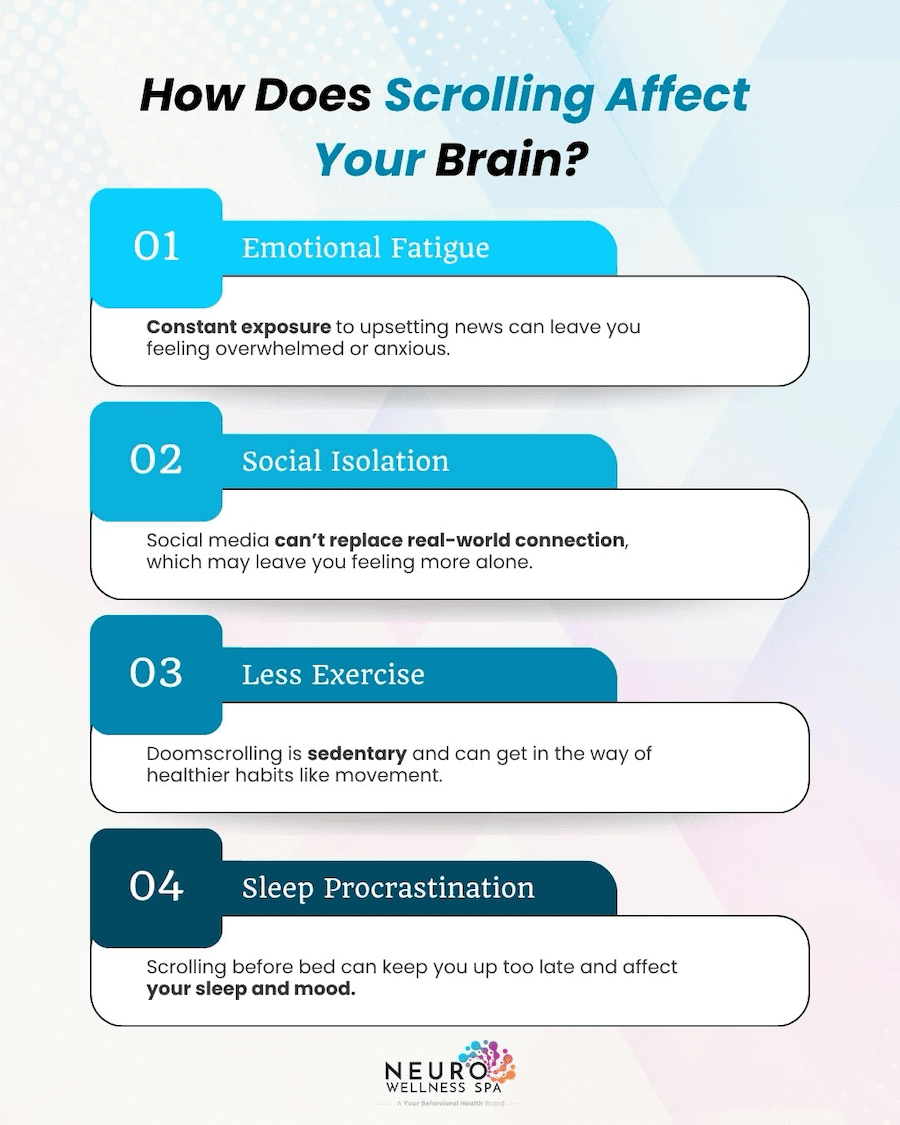
How Does Scrolling Affect The Brain?
Although a bit of screentime here and there isn’t bad, doomscrolling for hours can have significant consequences.
- Emotional fatigue – Constant exposure to distressing news can take a heavy emotional toll. You may end up feeling overwhelmed, anxious, and worse than before you started.
- Social isolation – Social media is not the same as real-world connections, and this can leave you feeling more isolated, despite being continuously plugged in online.
- Less exercise – Doomscrolling is usually a sedentary habit and can get in the way of exercise or other healthier activities, which can impact your mental and physical health.
- Sleep procrastination – Many people doomscroll at night, right before bed. Struggling to put the phone down can lead to staying up too late, affecting your sleep and mood the next day.
Some studies show that doomscrolling is also associated with emotional desensitization and shortened attention spans.3
Doomscrolling can also affect how you interact with others. Spending long periods of time passively consuming content can take away from real-life conversations and meaningful connections. Over time, this may make it harder to stay present, engage socially, or feel connected to the people around you, even if you are constantly “connected” online.
Are you stuck doomscrolling? Find healthier ways to relax and unwind by talking to our experts today.
Bad News can Negatively Affect Your Perception
Doomscrolling can also lead to a distorted perception of reality. While bad news is inevitable, not everything is so dreary. Unfortunately, with the way that social media feeds and news algorithms work, your search and scrolling habits may negatively influence your newsfeed, keeping it full of more distressing information instead of positive news or uplifting stories.
Over time, this can create what’s known as an echo chamber. Social media platforms tend to show you more of the content you engage with, meaning that if you frequently click on negative or distressing stories, you are more likely to see even more of them. This repetition can reinforce fear, anxiety, and negative beliefs about the world, making situations feel more overwhelming or hopeless than they actually are.
For teens especially, this can extend to how they feel about their own future. When a young person’s feed is filled with crisis and conflict, it’s easy to start feeling like things will never get better. It’s important to remember that your algorithm is not an accurate picture of reality.
It’s normal to want to stay informed. However, it’s important to set a limit on how long you scroll and know when it’s time to put your phone down.
Related: What To Do When Your Teen Watches Graphic Online Content: 5 Tips To Deal With Secondary Trauma
What Are the Signs of Doomscrolling?
Doomscrolling behavior is a slippery slope, but there are some signs that you may be surfing your feed for too long. Some things to look out for include:
- Constantly checking your feeds or push notifications for updates, even after just a few minutes have passed.
- Feeling sad, anxious, or angry after reading the news, but still feeling compelled to scroll.
- Spending hours watching the news and scrolling online, especially late at night.
- Putting off work or hobbies to keep reading negative content.
- Feeling as though you’re falling into a rabbit hole of bad news and mindlessly shifting from one negative story to another.
- Experiencing eye strain, headaches, or fatigue.
Many people doomscroll to feel more in control. Unfortunately, it usually backfires. Continuously checking and refreshing your newsfeeds only increases your anxiety, keeping you in a self-perpetuating cycle that’s difficult to break free from.
Is Doomscrolling Addictive?
Doomscrolling may not be classified as a formal addiction, but it can become highly habit-forming and difficult to control.
Social media platforms are designed to keep you engaged for as long as possible. Each scroll, notification, or new piece of content can trigger small releases of dopamine in the brain, the same reward chemical involved in other habit-forming behaviors. This creates a loop where you feel compelled to keep scrolling, even when the content is upsetting or no longer enjoyable.
As Chris Manno, AMFT, a therapist at Neuro Wellness Spa, puts it:
“Doomscrolling isn’t curiosity, it’s anxiety looking for evidence. And the more you scroll to find certainty, the more you train your mind to expect catastrophe.”
Over time, doomscrolling can start to feel automatic. You might reach for your phone without thinking, lose track of time while scrolling, or feel restless or uncomfortable when you try to stop. For some people, it can begin to mirror patterns seen in behavioral addictions, where the urge to engage continues despite negative effects on mood, sleep, or daily functioning.
When doomscrolling becomes a primary way to cope with stress or avoid difficult emotions, it can be even harder to break. Recognizing these patterns is an important first step toward regaining control and building healthier habits.
Tips To Stop Doomscrolling
It’s important to stay aware of current events. However, it’s also important to create healthy boundaries around how much of this online content you consume. Here are some tips to help you get started:
- Practice present-minded activities like meditation, breathwork, or yoga to help ground yourself and reduce the anxiety that can fuel doomscrolling.
- Try to avoid looking at any screens for the first 30 minutes after waking up. This helps set the tone for your day.
- Replace the time you’d usually spend on social media with a healthier habit, like reading a book.
- Set a time limit on how long you allow yourself to scroll online.
- Turn off news and social media notifications on your phone.
- Choose a couple of news sources to check daily, then disengage. This helps set healthy boundaries and reduces the negative impact of bad news on your mental health.
- Unfollow negative news and curate your feeds to show more positive stories that make you feel good.
If scrolling on your phone tends to be an ongoing issue, consider deleting those social media platforms and news apps that are the most problematic for you. You could also make a pledge to only use those apps on your computer for a set amount of time.
What Are Some Alternatives to Doomscrolling?
Not sure what to do now that you’ve put your phone down? Here are just a few ideas to help you fill up that newfound free time:
- Try microlearning apps, enroll in an online course, or learn a new language.
- Watch educational documentaries or try out a new hobby.
- Take on new organizational projects to declutter your space.
- Get moving and take a quick walk while listening to music or your favorite uplifting podcast.
- Meal prep for the week or research and try out new recipes.
- Keep a small journal with you. During those times when you’d pull your phone out and start scrolling, pick up your journal and write instead.
Remember, these are just a few examples of healthier ways to spend your free time. If it’s especially challenging for you to disconnect or cut down on time spent online, consider going analog. Walk away from your phone altogether and take a break. You could try putting it away in a drawer or in another room. You could also simply turn it off for a while. Remember, you can always turn it back on when you need to.
If doomscrolling has become your go-to way to cope, it might be time for something that actually helps you feel better. You don’t have to figure it out alone, reach out today.
What To Do if You’re Still Struggling
There is a balance between staying informed about important current events and falling into a doomscrolling spiral. Staying informed means that you check in with the headlines or a specific event and then go about your day. Doomscrolling leaves you feeling powerless, anxious, and worse than before.
Doomscrolling can be a hard habit to break, but with some practice, it can be done. However, some people may still struggle to stop, even when they try their hardest. For some, excessive social media use can worsen any underlying mental health symptoms they may be dealing with.
If you’ve tried everything you can think of and still struggle to break the cycle, it’s okay to ask for help. At Neuro Wellness Spa, our mental health professionals can help you understand why you doomscroll and address any underlying issues or concerns you have.
By starting with a comprehensive mental health evaluation, our team can work together with you to determine the right course of treatment. Treatment can help you build healthier coping skills, process difficult emotions instead of avoiding them, and improve your ability to stay present and engaged in your daily life.
Options may include:
- Talk therapy
- In-person and online psychiatry and medication management
- A combination of both
Through personalized mental health care, we can work together to support your unique path to healing.
References
- Price M, Legrand AC, Brier ZMF, van Stolk-Cooke K, Peck K, Dodds PS, Danforth CM, Adams ZW. Doomscrolling during COVID-19: The negative association between daily social and traditional media consumption and mental health symptoms during the COVID-19 pandemic. Psychol Trauma. 2022 Nov;14(8):1338-1346. doi: 10.1037/tra0001202. Epub 2022 Feb 14. PMID: 35157484; PMCID: PMC10074257. https://pmc.ncbi.nlm.nih.gov/articles/PMC10074257/.
- Levy I, Schiller D. Neural Computations of Threat. Trends Cogn Sci. 2021 Feb;25(2):151-171. doi: 10.1016/j.tics.2020.11.007. Epub 2020 Dec 28. PMID: 33384214; PMCID: PMC8084636. https://pmc.ncbi.nlm.nih.gov/articles/PMC8084636/
- Yousef AMF, Alshamy A, Tlili A, Metwally AHS. Demystifying the New Dilemma of Brain Rot in the Digital Era: A Review. Brain Sci. 2025 Mar 7;15(3):283. doi: 10.3390/brainsci15030283. PMID: 40149804; PMCID: PMC11939997. https://pmc.ncbi.nlm.nih.gov/articles/PMC11939997/