

We live in a digitally saturated society — social media and online platforms are nearly unavoidable, especially for teens who don’t know a world without the internet or smartphones. According to a 2023 study, 96% of teens use the internet daily, with 46% being online almost constantly.1 This means that teens are particularly vulnerable to being exposed to violent, graphic, and disturbing videos and images that circulate online, despite content restrictions implemented by parents and platforms alike.
Watching graphic content poses serious mental health risks, including vicarious trauma — otherwise known as secondary trauma. Vicarious trauma is the cumulative emotional toll of witnessing traumatic events, violent experiences, or shocking incidents that happen to someone else. If you’re a parent worried about your teen developing vicarious trauma, you’re not alone. Here are some signs to look out for, prevention strategies, treatment approaches, and how to implement healthy digital boundaries.
Our psychiatrists offer evidence-based mental health treatments and the latest psychiatric medication options through convenient online visits across California or in-person at our locations in the Los Angeles area. Schedule your appointment today.
Understanding Secondary Trauma in the Teenage Brain
According to Jamie Waarbroek, a psychiatric mental health nurse practitioner (PMHNP) for Neuro Wellness Spa in Pasadena, “Teens’ developing brains and social pressures make them highly vulnerable to vicarious trauma from graphic online content, so I encourage parents to prioritize open dialogue and set healthy digital boundaries to protect their mental well-being. By fostering trust through curious and nonjudgmental conversations, parents can help teens process distressing media exposure. Establishing tech-free routines and encouraging purposeful activities, like volunteering, can further empower teens to regain control and build resilience against secondary trauma.”
These insights about indirect trauma exposure highlight why understanding teen’s unique vulnerabilities is crucial for parents who want to protect their teens from digital secondary trauma.
Why teens are particularly vulnerable
The teenage years are a critical period of development — neurologically and socially — which makes them particularly vulnerable to the impacts of vicarious trauma. From a neurological perspective, when the teenage brain is under construction it is especially malleable and sensitive, and they don’t have the emotional regulation to respond appropriately. This means when teens view traumatic content, it can reinforce trauma-response pathways, they feel it more intensely, it can be challenging for them to contextualize it, and they may struggle to take their eyes off the screen due to their underdeveloped impulse control.
From a social perspective, teens are trying to fit in and form their friend groups, which often means being online more to stay connected and sharing sensational content to get a rise out of their peers. They are also spending more time unsupervised, and this newfound freedom can lead them to exploring dark parts of the internet, or circumventing content restrictions.
The cumulative effect of digital exposure
While a single incident of graphic media exposure can cause an acute stress response, it’s unlikely that it will lead to secondary trauma unless the video is extremely graphic or personally triggering. However, here’s the problem: social media algorithms reward engagement, and graphic content can play into one’s morbid curiosity and be disturbingly captivating. The result is that the algorithm may place more graphic content onto your feed, increasing the likelihood you’ll develop vicarious trauma.
This is where “doom scrolling” comes in — or the constant and compulsive consumption of disturbing or distressing content. Our brain naturally pays more attention to threatening situations, and the infinite scroll design of media platforms feeds us with limitless content to consume without natural stopping points. For teens, this can be particularly dangerous — research shows that each new exposure to traumatic content can increase the risk of developing post-traumatic stress disorder (PTSD) by nearly 30%.2
Get Treated: Psychiatry, Psychotherapy, and TMS Therapy for Adolescent PTSD
Recognizing Secondary Trauma: Beyond the Obvious Signs
Unlike direct trauma responses that come with obvious symptoms parents might recognize, secondary traumatic stress develops subtly and intensifies with each new exposure.
Physical manifestations often missed
If you’re a parent, watch for these somatic symptoms that may indicate signs of vicarious trauma in your teen:
- Consistent fatigue despite seemingly getting adequate sleep.
- Noticeable appetite changes or weight fluctuations.
- Your child is increasingly complaining about stress-related stomach issues.
- You notice they are breaking out beyond puberty-related skin problems.
- Your child is complaining about migraines, which could be a result of “tech neck.”
Behavioral changes parents overlook
In addition to physical manifestations, behavioral changes that may indicate vicarious trauma in your teen include:
- Paranoid behaviors, such as excessively checking locks or alarms.
- New rituals or compulsive behaviors regarding safety and security.
- Overprotectiveness of younger siblings or friends.
- Sudden preoccupation with survival skills or self-defense.
- Anhedonia — or loss of interest in daily activities — without clear explanation.
Digital behavior red flags
Noticing changes in your teen’s technology habits can be a helpful indicator of whether they are developing media-related secondary trauma and include:
- Checking distressing news stories compulsively.
- Creating multiple “backup” media accounts.
- Fact-checking or bringing up news stories excessively.
- Sharing traumatic content as a way to cope.
- Implementing extremely prohibitive content restrictions, followed by binge-watching graphic content.
- Following accounts that are dedicated to posting graphic media.
Related: Understanding and Addressing Teen Anxiety
5 Tips To Support Teens After Secondary Trauma
If you notice any of the aforementioned red flags, it’s important to take prompt action to avoid escalation of secondary trauma. Here’s a summary of 5 tips to support teens after experiencing secondary trauma.
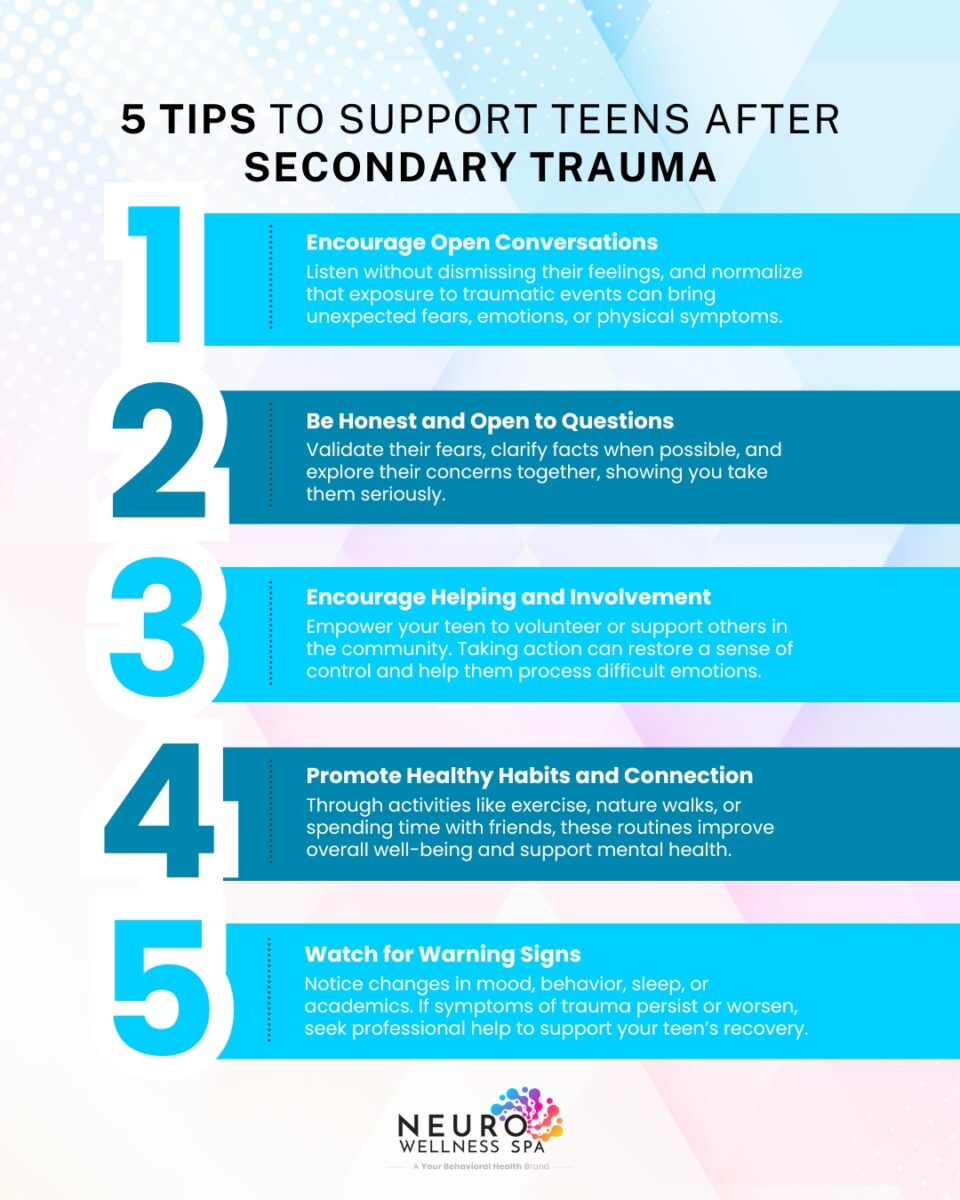
1. Create space for difficult dialogues
Encouraging open discussions with your teen about their digital media habits can foster trust and understanding. During a time where your kid is trying to establish their independence, avoid invasively forcing these conversations. Instead, lead with curiosity, let the conversations happen on your teen’s terms, and observe any nonverbal cues.
When you’re vulnerable, it can set the stage for your teen to be vulnerable too, so consider starting with a story about traumatic media you watched and the effects it had on you. Listening may be more important than offering immediate help, so give your child the space to share their thoughts and experiences. Additionally, consider establishing regular check-ins to avoid them feeling like they are being ambushed.
2. Provide transparent, grounded responses
While intentional listening should be a priority, responding appropriately is also important. Examples of what to say in these conversations include:
- “I can see why that post could’ve been distressing. Would you like to talk about how you feel about it?”
- “I appreciate you sharing what you witnessed. How did it affect you?”
- “The internet is filled with misinformation. Can we research this together to get to the bottom of it?”
- “Was this a post that just appeared on your feed, or did you search for it?”
- “How can I help you avoid seeing similar content in the future?”
Conversely, things you should avoid saying include:
- “That’s nothing to worry about, you’ll be fine.”
- “That’s why you should never ____.”
- “How did you see that? I thought I told you not to watch things like that.”
- “Show me exactly what you saw.”
- “Oh that’s nothing, I’ve seen way worse.”
3. Transform helplessness into purpose
When teens witness graphic content, it can trigger existential questions like, “What if that happened to me?” and perpetuate feelings of helplessness. One powerful antidote to helplessness is helping them regain their sense of control through channeling distress into action — whether through volunteering for a cause they care about or helping a loved one. You can even create family service projects together, strengthening their sense of community while helping reinforce their sense of purpose.
4. Strengthen daily anchors and relationships
Another way to reestablish your teen’s sense of control is by building routine and reinforcing the importance of connection. When you incorporate regularly scheduled, technology-free activities with family and friends, such as exercise, family games, sports, or weekly arts-and-crafts, you not only foster predictable moments of connection, but you give your teen breaks from the online world that they may feel overwhelmed by. Additionally, you can establish “comfort routines” — rituals to wind down and decompress after witnessing distressing content. Studies show that maintaining established routines is associated with smaller increases in PTSD symptoms during distress.3
Related: Understanding PTSD Therapy
5. Recognize red flags and take prompt action
While it’s important to watch for the physical, behavioral, and digital warning signs discussed earlier, knowing how to respond is just as important. Avoid aggressive confrontations — instead choose a calm moment to engage in an open discussion. Give yourself a set timeline — such as a 2-week window — to monitor if symptoms are becoming more severe or if there are any disruptions in daily routine, school attendance, or social engagement.
If symptoms persist or worsen during this period, seek professional support through a school counselor, pediatrician, or a mental healthcare provider who specializes in adolescent trauma. Avoid waiting for a crisis to act, but if you’re worried that your teen might harm themselves or others, call the Suicide and Crisis Lifeline at 988.
Related: Understanding and Addressing Teen Depression
When Professional Support Becomes Essential
If your teen’s secondary trauma is creating mental health challenges that interfere with daily functioning, there are several resources you can turn to that will provide proper support, teach them coping strategies, and put them on the path toward healing.
Critical warning signs requiring immediate help
There are several red flags to monitor that may indicate immediate help is necessary, including:
- Coping through substance use.
- Withdrawing socially or school refusal that lasts 2 weeks or more.
- Increasing severity and frequency of panic attacks.
- Dissociative episodes or behaviors that indicate they’re experiencing distorted reality.
- Self-harm behaviors or suicidal ideation.
- Call the Suicide and Crisis Lifeline at 988.
These warning signs can be dangerous and life-threatening. It’s important to remember that seeking immediate help in these situations isn’t overreacting — it’s taking the necessary actions to protect your teen’s well-being, and early intervention often leads to better outcomes.
IOP for secondary trauma
If a more intensive level of care is recommended for your teen, they may benefit from an intensive outpatient program (IOP). This program provides comprehensive support through group therapy sessions, support groups, individual counseling, psychoeducation, and peer connection with other young people that are struggling with similar struggles with mental disorders — all while allowing your teen to maintain their day-to-day responsibilities. They will learn healthy self-care and coping skills, strategies to implement healthy comfort routines, and ways to build emotional resilience after witnessing distressing online content.
Related: LGBTQ Youth Mental Health
How Your Behavioral Health Can Support Your Teen With Secondary Trauma
At Neuro Wellness Spa, we understand that today’s digital landscape makes teens more vulnerable than ever to vicarious traumatization. That’s why our mental health professionals are trained to deliver trauma-informed treatment specifically adapted to teen needs. We offer adolescent psychiatry, talk therapy, or transcranial magnetic stimulation (TMS) therapy — an innovative, drug-free treatment that can effectively address trauma symptoms in teens.
If your teen needs more intensive support, our sister program, Clear Behavioral Health’s Teen IOP provides adolescent-focused care 3 to 5 days per week. The program combines evidence-based modalities such as cognitive behavioral therapy (CBT) and dialectical behavior therapy (DBT), delivered by compassionate, trauma-informed mental health experts. Teens will receive the support and guidance they need during the day, and your teen will still be able to return home after treatment and stay connected with family. Additionally, we handle the transfer paperwork — that way, you don’t have to start the treatment process over and you can be confident in the continuity of care of your child.
Don’t let your teen struggle with secondary trauma alone — contact Neuro Wellness Spa today.
Resources
- Youth Statistics: Internet and social Media – ACT for Youth. (n.d.). https://actforyouth.org/adolescence/demographics/internet.cfm
- Da Silva, H. C., Vilete, L., Coutinho, E. S. F., Luz, M. P., Mendlowicz, M., Portela, C. M., Figueira, I., Ventura, P., De Jesus Mari, J., Quintana, M. I., Ribeiro, W. S., Andreoli, S. B., & Berger, W. (2024). The role of childhood cumulative trauma in the risk of lifetime PTSD: An epidemiological study. Psychiatry Research, 336, 115887. https://doi.org/10.1016/j.psychres.2024.115887