

Situational depression is a type of short-term depression that’s triggered by specific circumstances (like personal loss, divorce, or other big life events). Anyone can experience situational depression. Learn more about how long you can expect your symptoms to last, healthy ways to cope, and the importance of asking for help early.
If something has happened and you haven’t felt like yourself since, you don’t have to figure it out alone. Reach out whenever you’re ready.
What Is Situational Depression?
Situational depression (also known as reactive depression) refers to depression symptoms that may develop for a short time after facing a significant stressful life event. These types of events overwhelm your ability to cope.
While situational depression is a type of depression, there is no formal diagnosis for it. If symptoms last long enough, mental health professionals may diagnose a person with adjustment disorder with depressed mood if they meet the criteria.1
Alexandria Schuller, LMFT, a therapist at Neuro Wellness Spa, puts it simply:
“Situational depression can affect anyone, and needing support during a difficult time does not mean you are weak or incapable.”
What are the Symptoms of Situational Depression?
The symptoms of situational depression are complex. While most people feel immense sadness, they may also experience the following:
- Feeling hopeless
- Trouble making decisions
- Losing interest in hobbies
- Changes in appetite
- Overwhelming sadness, anxiety, and frequent crying
- Irritability and mood swings
- Avoiding social situations
- Withdrawing from friends and family
- Moving and talking more slowly
- Insomnia or sleeping too much
- Having trouble managing daily tasks at work and school
With situational depression, you may spend a lot of time focusing on the event and worrying that things will not improve. With time, many people do feel better, and their symptoms improve once they adjust (or the trigger is removed).
Related: Understanding Depression Symptoms and How To Cope With Them
Does any of this sound like what you’re going through? It might be time to talk to someone. Give us a call, we’re here to help.
What Can Trigger Situational Depression?
Stressors that can lead to situational depression are highly personal. They depend on what you find hard to deal with. Some triggers include:
- Relationship issues like separation or divorce
- Retirement or job loss
- Financial or work stress
- Injury or illness
- Moving
- The death or illness of a loved one
- Physical assault
- Natural disaster
Not everyone reacts in the same way to the same situation. For example, while two people may struggle in the aftermath of a death, one person may eventually accept this loss and begin to move forward. Meanwhile, the other person may continue to struggle for a long time without professional help.
How Long Does Situational Depression Last?
Situational depression usually lasts for a few months and gets better over time (usually about six months). Although it is a temporary response to difficult situations, some may need therapy if symptoms continue to interfere with daily life.
Related: How Long Does Depression Last?
Situational Depression vs. Clinical Depression: What’s the Difference?
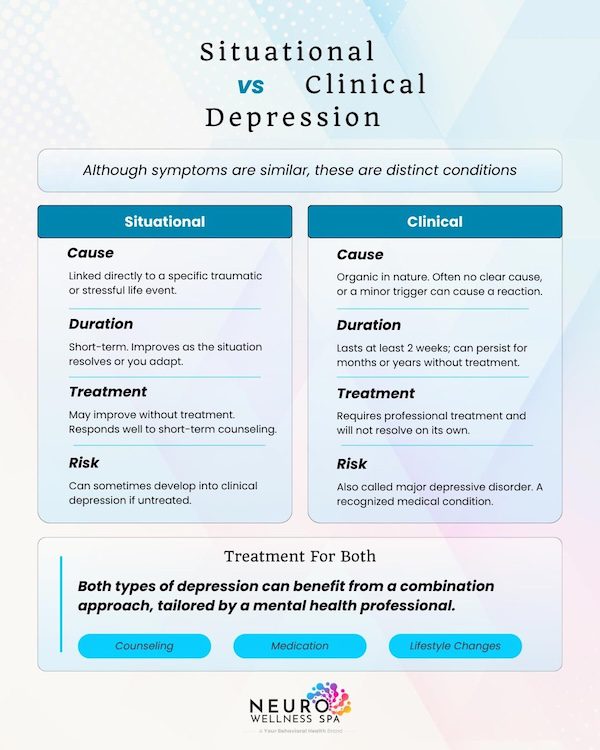
Although the symptoms are similar, situational depression differs from clinical depression.
With situational depression, the cause is directly linked to a specific traumatic event. Symptoms are short-term and improve as the situation resolves or you adapt. Situational depression can sometimes improve without treatment, but it also responds well to short-term counseling. However, in some cases, situational depression may develop into clinical depression.
Clinical depression is organic.2 There is often no clear cause, or there may be a minor trigger that causes an intense reaction. Clinical depression also lasts for at least two weeks, but can go on for months or years without treatment.
Treatment for both types of depression can require a combination of counseling, medication, and lifestyle adjustments.
Related: What Is Depression? From Diagnosis to Treatment
How Do You Treat Situational Depression?
For some, situational depression may get better on its own over time. Getting support from friends, family, and mental health professionals can also be helpful.
Talk Therapy
Counseling offers a safe space to talk about your feelings and help you develop coping skills and strategies you can use when you’re feeling overwhelmed.
Since situational depression is linked to a specific event, your counselor may help you identify ways to process your emotions regarding the situation. For example, they can help you think through your feelings, challenge your negative thought patterns, and reframe these with more realistic perspectives.
Related: Exploring Different Types of Therapy
Lifestyle Changes
Lifestyle changes are steps you can take to help you heal. These might include:
- Getting regular physical activity, like going out for a walk
- Sleeping at least 7 to 9 hours a day
- Focusing on a healthy, nutrient-dense diet
- Leaning on family, friends, and group support
Some people respond very well to lifestyle changes and start to feel better after a while. Others may require a little more help in the form of professional therapy or medication.
Can Antidepressants Be Used for Situational Depression?
Many times, situational depression can be resolved with lifestyle adjustments and therapy. But, in some cases, antidepressants are used alongside other treatments, especially if symptoms are severe.3
Because situational depression develops as a reaction to a specific stressor, medication is often prescribed on a short-term basis to help you navigate the crisis. Many find that a mix of medication and therapy is most effective.
Is Situational Depression an Official Diagnosis?
While situational depression is not a formal diagnosis found in the DSM-5, it is still a well-recognized phenomenon that happens after a big life event. Many mental health professionals may classify it as a type of adjustment disorder with depressed mood.
What Is Adjustment Disorder?
An adjustment disorder is a psychological response to a stressor that results in the development of significant symptoms that affect your daily life.4
There are several different subtypes of adjustment disorders, including adjustment disorder with depressed mood. This subtype is characterized by tearfulness, depressed mood, and feeling hopeless. Symptoms must develop within 3 months in response to the stressor.
What Are the Symptoms of Adjustment Disorder With Depressed Mood?
Adjustment disorder symptoms often involve intense distress, worry, and difficulty coping with challenging life circumstances. Physical symptoms include fatigue, insomnia, and generalized pain (like headaches and stomachaches).
How Is Adjustment Disorder With Depressed Mood Diagnosed?
For this diagnosis, you must be evaluated by a mental health professional to see if you meet the criteria.5 They will conduct a thorough interview with you to assess your symptoms and history. A doctor may also conduct a physical exam and lab tests to rule out other potential causes of your symptoms.
Self-Care Strategies for Situational Depression
When bad things happen in life, it can feel very hard (and even impossible) to move forward. Along with mental health treatment, here are some things you can do to take care of yourself as you deal with challenges.
Physical Health and Daily Routines
Even if you don’t feel like doing it, try to maintain a regular bedtime and wake-up time. Decide what tasks to prioritize every day, whether it’s going to work, getting a few easy chores done, or cooking a healthy meal. Try to get a bit of physical activity too, since it’s a natural mood booster.6
Emotional and Social Support
Stressful times can feel overwhelming, and many of us tend to self-isolate. Although it may be hard to do, try to reach out and connect with friends and family. Even a short text or phone call can help you feel less lonely. Share how you’re feeling with a trusted person to help lighten your emotional load. Mindfulness techniques may also help you calm your mind when you start having unhelpful thoughts.7
Helpful Coping Strategies
Remember, the way you’re feeling right now is a temporary reaction to hard times. Be gentle with yourself and allow time to heal. Many tasks may feel unmanageable right now, but try breaking larger ones into smaller, more manageable steps. Avoid making any major life decisions for now until you start feeling better.
Avoiding Negative Coping Mechanisms
When you’re depressed or upset, you may feel tempted to turn to drugs, nicotine, and alcohol. However, these substances can worsen your mood and cause other problems. If social media is adding to your stress, reduce screentime. Consider journaling to help you process your emotions and stop ruminating.8,9
Schuller reminds her clients that:
“Healing looks different for everyone, and with compassion, connection, and the right support, many are able to regain a sense of stability and hope.”
Hard times don’t have to be carried alone. Give us a call, it’s one of the best things you can do for yourself right now.
How Neuro Wellness Spa Can Help Treat Your Depression
Major life changes can leave you feeling stuck, overwhelmed, or unsure of where to turn next. At Neuro Wellness Spa, our compassionate clinicians understand how situational depression shows up in real life and how isolating it can feel to carry it alone.
We work with you to build practical coping tools and identify treatment options that align with your needs and goals. Whether support looks like talk therapy, medication management, or structured, non-medication approaches, our team helps you take manageable steps toward feeling more like yourself again, even when what you’re going through doesn’t feel “serious enough” to ask for help.
Frequently asked questions
Read through our FAQ for any questions you may have about situational depression, or give us a call today. We are here to answer your questions and support you or your loved one through their healing journey.
Is situational depression serious?
Yes, situational depression can be very serious. People think that it’s not serious because it’s temporary. But that is not the case. In some cases, it may worsen and put the person at risk of self-harm and other serious behaviors.
What is reactive depression?
Reactive depression is also known as situational depression. It is a type of depression that occurs in response to a stressor, like a major move (to another country, for instance).
Can situational depression go away on its own?
In some cases, it can. But symptoms can be intense and worsen significantly. It’s always best to seek help.
References
- Carta MG, Balestrieri M, Murru A, Hardoy MC. Adjustment Disorder: epidemiology, diagnosis and treatment. Clin Pract Epidemiol Ment Health. 2009 Jun 26;5:15. doi: 10.1186/1745-0179-5-15. PMID: 19558652; PMCID: PMC2710332. https://pmc.ncbi.nlm.nih.gov/articles/PMC2710332/
- Kanter JW, Busch AM, Weeks CE, Landes SJ. The nature of clinical depression: symptoms, syndromes, and behavior analysis. Behav Anal. 2008 Spring;31(1):1-21. doi: 10.1007/BF03392158. PMID: 22478499; PMCID: PMC2395346. https://pmc.ncbi.nlm.nih.gov/articles/PMC2395346/
- Sheffler ZM, Patel P, Abdijadid S. Antidepressants. [Updated 2023 May 26]. In: StatPearls [Internet]. Treasure Island (FL): StatPearls Publishing; 2026 Jan-. Available from: https://www.ncbi.nlm.nih.gov/books/NBK538182/
- Substance Abuse and Mental Health Services Administration. Impact of the DSM-IV to DSM-5 Changes on the National Survey on Drug Use and Health [Internet]. Rockville (MD): Substance Abuse and Mental Health Services Administration (US); 2016 Jun. Table 3.19, DSM-IV to DSM-5 Adjustment Disorders Comparison. Available from: https://www.ncbi.nlm.nih.gov/books/NBK519704/table/ch3.t19/
- O’Donnell ML, Agathos JA, Metcalf O, Gibson K, Lau W. Adjustment Disorder: Current Developments and Future Directions. Int J Environ Res Public Health. 2019 Jul 16;16(14):2537. doi: 10.3390/ijerph16142537. PMID: 31315203; PMCID: PMC6678970. https://pmc.ncbi.nlm.nih.gov/articles/PMC6678970/
- Ligeza TS, Maciejczyk M, Wyczesany M, Junghofer M. The effects of a single aerobic exercise session on mood and neural emotional reactivity in depressed and healthy young adults: A late positive potential study. Psychophysiology. 2023 Jan;60(1):e14137. doi: 10.1111/psyp. 14137. Epub 2022 Jul 5. PMID: 35790005; PMCID: PMC10078493.https://pmc.ncbi.nlm.nih.gov/articles/PMC10078493/
- Hofmann SG, Gómez AF. Mindfulness-Based Interventions for Anxiety and Depression. Psychiatr Clin North Am. 2017 Dec;40(4):739-749. doi: 10.1016/j.psc.2017.08.008. Epub 2017 Sep 18. PMID: 29080597; PMCID: PMC5679245. https://pmc.ncbi.nlm.nih.gov/articles/PMC5679245/
- Sohal M, Singh P, Dhillon BS, Gill HS. Efficacy of journaling in the management of mental illness: a systematic review and meta-analysis. Fam Med Community Health. 2022 Mar;10(1):e001154. doi: 10.1136/fmch-2021-001154. PMID: 35304431; PMCID: PMC8935176. https://pmc.ncbi.nlm.nih.gov/articles/PMC8935176/
- Michl LC, McLaughlin KA, Shepherd K, Nolen-Hoeksema S. Rumination as a mechanism linking stressful life events to symptoms of depression and anxiety: longitudinal evidence in early adolescents and adults. J Abnorm Psychol. 2013 May;122(2):339-52. doi: 10.1037/a0031994. PMID: 23713497; PMCID: PMC4116082. https://pmc.ncbi.nlm.nih.gov/articles/PMC4116082/